|
Some orgs make a splash, others do pretty much zip. ͏ ͏ ͏ ͏ ͏ ͏ ͏ ͏ ͏ ͏ ͏ ͏ ͏ ͏ ͏ ͏ ͏ ͏ ͏ ͏ ͏ ͏ ͏ ͏ ͏ ͏ ͏ ͏ ͏ ͏ ͏ ͏ ͏ ͏ ͏ ͏ ͏ ͏ ͏ ͏ ͏ ͏ ͏ ͏ ͏ ͏ ͏ ͏ ͏ ͏ ͏ ͏ ͏ ͏ ͏ ͏ ͏ ͏ ͏ ͏ ͏ ͏ ͏ ͏ ͏ ͏ ͏ ͏ ͏ ͏ ͏ ͏ ͏ ͏ ͏ ͏ ͏ ͏ ͏ ͏ ͏ ͏ ͏ ͏ ͏ ͏ ͏ ͏ ͏ ͏ ͏ ͏ ͏ ͏ ͏ ͏ ͏ ͏ ͏ ͏ ͏ ͏ ͏ ͏ ͏ ͏ ͏ ͏ ͏ ͏ ͏ ͏ ͏ ͏ ͏ ͏ ͏ ͏ ͏ ͏ ͏ ͏ ͏ ͏ ͏ ͏ ͏ ͏ ͏ ͏ ͏ ͏ ͏ ͏ ͏ ͏ ͏ ͏ ͏ ͏ ͏ ͏ ͏ ͏ ͏ ͏ ͏ ͏ ͏ ͏ ͏ ͏ ͏ ͏ ͏ ͏ ͏ ͏ ͏ ͏ ͏ ͏ ͏ ͏ ͏ ͏ ͏ ͏ ͏ ͏ ͏ ͏ ͏ ͏ ͏ ͏ ͏ ͏ ͏ ͏ ͏ ͏ ͏ ͏ ͏ ͏ ͏ ͏ ͏ ͏ ͏ ͏ ͏ ͏ ͏ ͏ ͏ ͏ ͏ ͏ ͏ ͏ ͏ ͏ ͏ ͏ ͏ ͏ ͏ ͏ ͏ ͏ ͏ ͏ ͏ ͏ ͏ ͏ ͏ ͏ ͏ ͏ ͏ ͏ ͏ ͏ ͏ ͏ ͏ ͏ ͏ ͏ ͏ ͏ ͏ ͏ ͏ ͏ ͏ ͏ ͏ ͏ ͏ ͏ ͏ ͏ ͏ ͏ ͏ ͏ ͏ ͏ ͏ ͏ ͏
|
Hey there legend, A question I get asked a lot is: 'How do we convince our senior leaders we need to be bolder on social media?'
For a long time my answer usually looked something like this: Educate your organisation on why bold works Show the results others around you are getting Sell the dream of being appreciated online (and their place in that dream)
But increasingly there’s also another way in - a more negative, and frankly scarier one. A senior leader at a government department once told me: ‘Look, we understand we need to do social better, but for this to be a priority, we need a burning platform’. Well, there’s plenty of them around right now. Misinformation, coordinated influence campaigns, AI-generated deepfakes - all things public sector organisations are increasingly likely to encounter sooner rather than later. Just this last week I’ve seen pretty terrifying headlines about 100 accounts being responsible for the majority of conspiracy theory content in Canada, and AI-generated Iran war videos surging as creators use new tech to cash in. Using these examples obviously risks scaring the horses - or backfiring if it’s not done well. But they can also help focus attention on something important: the need for strategic, motivated, well-trained, and well-resourced social teams - who have the time to scan the horizon for risks, and the skills to respond when things start going sideways. Because the organisations that handle this hostile environment best will be the ones already present, credible, and trusted when the bad stuff arrives. Which is a very different conversation to ‘how do we post more memes?’ It’s about recognising that social media now plays a critical role in how information spreads, how trust is shaped online, and how organisations respond when things go wrong (which they will). If social media is becoming both a major opportunity and a real risk environment, then treating it as something that can be managed by a junior 0.5 FTE probably isn’t going to cut it anymore. Cheers 👋
Seamus Boyer
|
|
“Mediocre strategists believe that optimising the present is sufficient for success. Great strategists know they have to aim higher - or someone else will aim higher and succeed. That means balancing the exploitation of what is and the exploration of what might be. All forces will pull towards exploitation of what is. A great strategist needs to resist that pull and always invest time and energy in exploration of what might be.” - Roger Martin
|
|
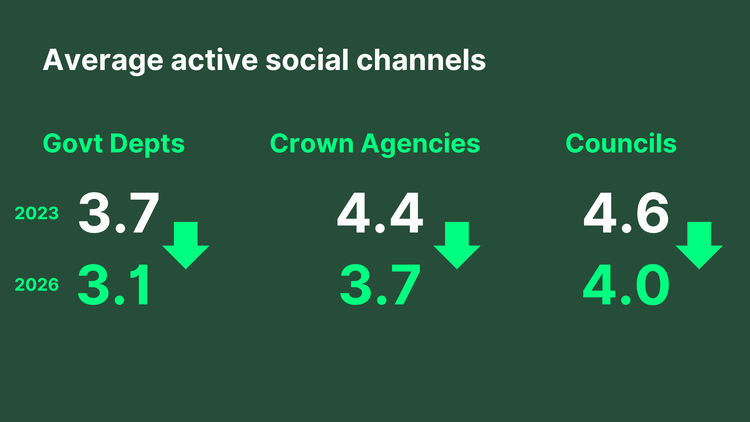
Twice a year I manually wade through the glorious morass that is 650+ government social pages (662 this last sweep). Last week I presented some of that research at a conference in Wellington, an event aimed at celebrating the successes of government comms. My session tried to place that success within the broader context of what’s happening across the sector - celebrating what’s working, yes, but also looking honestly at how things are evolving in the government social media space. Below is a snapshot of where we’re at, some of the challenges we’re navigating, and a possible way forward based on who is getting great results. Hope it sparks some thinking. 👇👇👇 What I discovered trawling 662 NZ govt socials…For starters, we are running fewer channels. A lot of this comes down to the ongoing X-odus from the platform formerly known as Twitter, but a few government departments have also recently ditched Facebook and Instagram. I’ve reported before that as of January 2026, only a handful of central government organisations in NZ still used X, and 0/78 councils did (whereas 46 councils did in 2023). This mass departure gets politicised occasionally, but the truth is that X stopped providing any semblance of ROI years ago. In terms of the average number of main corporate channels, the overall shift is pretty interesting, too. Government departments dropped from 3.7 channels in 2023 to 3.1 in 2026, Crown agencies from 4.4 to 3.7, and councils from 4.6 to 4.0.
|
|
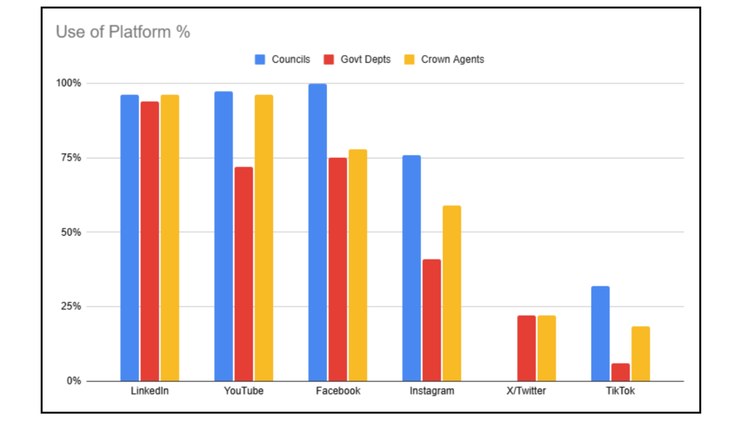
If you consider that for government departments one of their channels will likely be LinkedIn, and another Facebook, that only leaves 1.1 platforms left to communicate and connect with a whole variety of different audience demographics. Good luck with that. As the graph below shows, the third platform is most likely to be YouTube, which we know is excellent for reaching younger users (but also pretty much anyone - because literally everyone uses YouTube). In reality, we know YouTube is overwhelmingly used as a repository for video (I call it the graveyard for corporate videos), as well as council meeting livestreams. Neither of those uses fits particularly well with the fact people are increasingly viewing YouTube on television rather than phones or desktops (and there are very few government organisations that have the raw material to make good television). So, across the main six platforms, use is still largely concentrated in LinkedIn, Facebook and YouTube (albeit in very mixed ways and with mixed results). But after that, platform use drops off substantially - 75% of councils use Instagram, but under half of government departments do, and almost no one uses X.
|
|
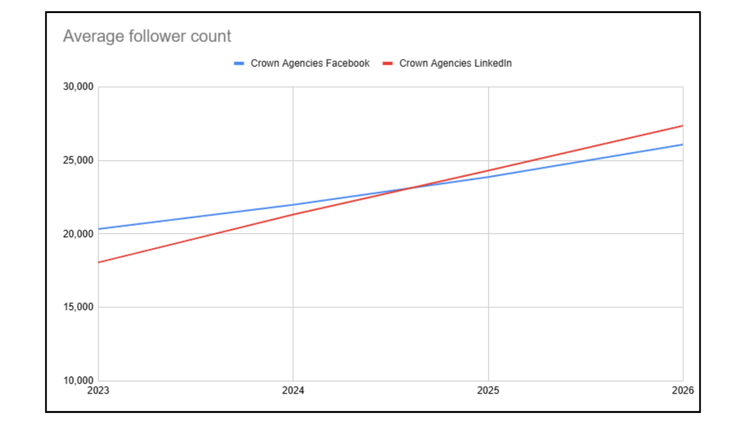
TikTok use is more interesting (and concerning TBH). The global phenomenon first invaded Kiwi consciousness at the end of 2019, so it’s far from new. It is extremely popular with younger demographics as we all know, and yet just 32% of NZ councils use it, along with 19% of Crown agencies, and a tiny 6% of government departments. These numbers should alarm us. Because as well as showing how slow the sector is to adapt its comms, it also starts to feel like a fairly deliberate choice not to connect with younger residents and citizens. At the other end of the channel spectrum, LinkedIn is becoming a real success story for the public sector. Audience growth there has been strong and consistent over the last two years for many organisations - in both local and central government - with the chart below showing average LinkedIn follower count for Crown agencies passing that of Facebook in mid-2024. For many government departments, LinkedIn is now the platform where they have their largest and most engaged audiences (it’s also safer and nicer).
|
|
Unfortunately, the strategy part hasn’t caught up with this audience growth. Most organisations are still posting heavily about news updates and job ads (the latter make up 20-50% of posts from many organisations - and up to 100% for a few true laggards). There is also little evidence of coordination with employee accounts, which is a crying shame given LinkedIn is one of the very places where that approach actually works. Overall, it’s a bit of a waste to have a growing strategic audience who wants to hear from you, but instead you give them a stale or purely job-centred view of who you are, what you do, and the value you provide. Instead, there are big LinkedIn content opportunities to: Show you have a plan (priorities) Show you are a good place to work (culture) Show you know your stuff (expertise) Celebrate your people and partners Lift the curtain (transparency)
Hopefully we’ll see some improvement here in 2026. Perhaps the biggest takeaway in NZ government social is that local government is pulling away from central, including in audience growth, driven by better quality content, more relevance, and more resonance. In the 12 months to January 2026, audiences across the main platforms grew 6% for government departments, 7.4% for Crown agencies, and a whopping 15.8% for councils. Some of this growth will be down to the fact that there were local government elections in October 2025 - but that provided context and opportunity rather than growth itself.
|
|
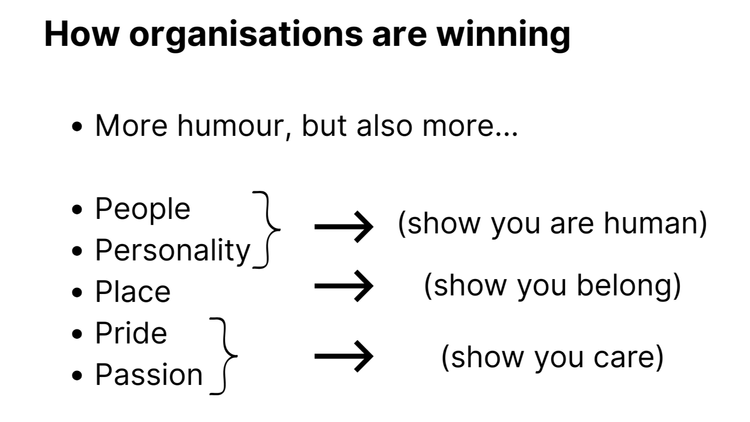
It was incredibly pleasing to see more and more councils leaning heavily into social-first content that actually looked like the kinds of things people engage with on these platforms (which, surprise surprise, tend to gain and hold attention). There were more memes, more skits, more trends, more dancing, more humour - and just more fun all around. And audiences loved it. Engagement was strong, sentiment was positive, and there were wonderful comments about being reminded and inspired to enroll and vote. It was a wonderful thing. Unfortunately, immediately after the elections many councils reverted to their old habits - business-unit news and updates, lacking coherence and impact. Once again, this shows the disconnect (strategically) between campaign comms/social and a lot of everyday storytelling. The former is often much more focused and dynamic than the latter. But let’s get back to the positive. Because more organisations are finding a winning formula in their content - one that features the conveniently P-based formula of people, personality, place, pride and passion.
|
|
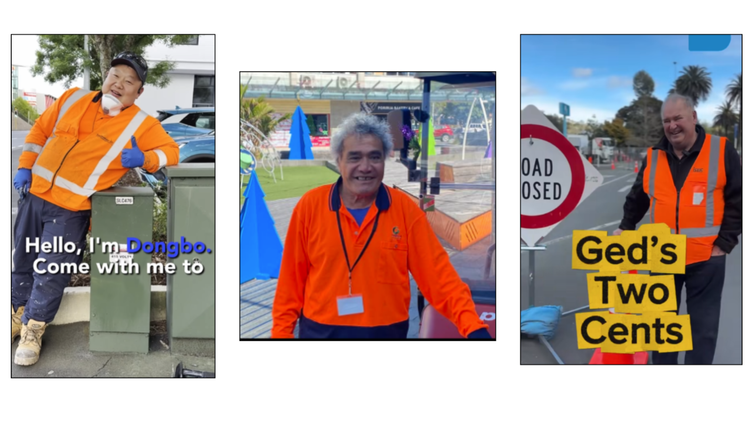
There is nothing new or mysterious in this. People and place especially (tangata and whenua in Māori) have been fundamental elements of resonant storytelling forever. Adding in personality, pride and passion as filters or amplifiers naturally helps to elevate content to a place where it immediately makes sense to audiences from a relevance point of view. We’re also just seeing more people-focused content in general - showcasing frontline staff, or using staff and partners to explain decisions, policies, projects or challenges. And adding personality helps make it fun and interesting (because, ya know, human connection). And before you say, ‘Wait a minute, we can’t put our people on social, it’s too risky’, remember that NZ Police have been putting their staff on camera forever, and NZTA have been doing Roadworker of the Week for about two years now. And those two orgs are likely carrying far more potential risk in online spaces than you are.
|
|
|
Left to right: Hamilton City Council, Porirua City Council, Nelson City Council. |
|
|
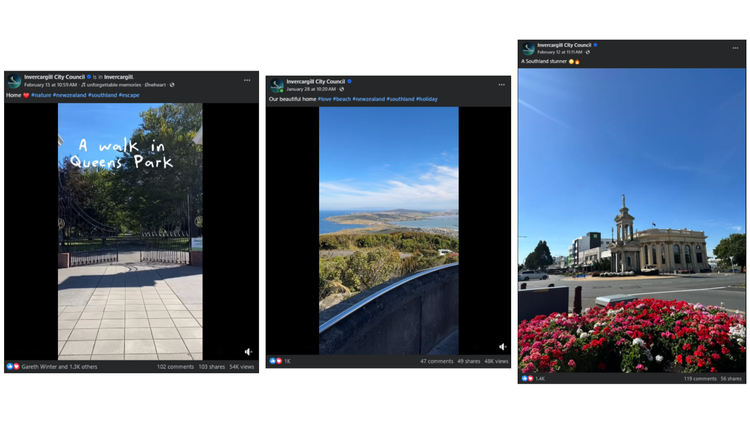
And finally, the local pride piece. Such an important and underused tool. An organisation that does this particularly well is Invercargill City Council, expertly balancing pride-based and humour-based engagement posts alongside more “important” but often duller inform and consult posts. Again, there is no mystery to why this content works. Regularly reminding people why they enjoy living in the place they do is always going to be effective. For a smallish council at the bottom of the world, Invercargill put up seriously impressive numbers - strong growth and engagement across Facebook, Instagram and TikTok. The foresight to build this into a strategic approach, the discipline to execute consistently, and the bravery to experiment with local language, humour and culture all combine into a winning formula.
|
|
|
Honestly I’m sick of talking about Invercargill City Council, but they grew their audiences by 77% in the 12 months to January 2026. Which is completely ridiculous really. |
|
|
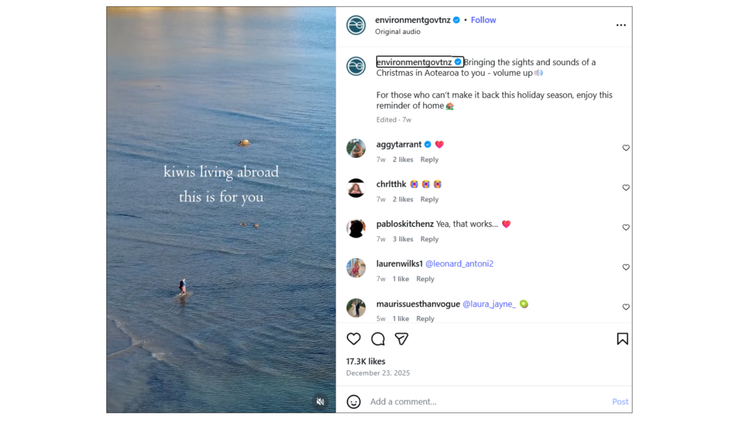
Appealing to local pride can also work for national organisations or government departments that serve the whole population. Take this short reel from the Ministry for the Environment. Posted just before Christmas, it features some nice but fairly generic shots of NZ with audio of the ocean, birds and the outdoors layered over the video. It starts “Kiwis abroad, this is for you”, and the caption continues: “Bringing the sights and sounds of a Christmas in Aotearoa to you - volume up. For those who can’t make it back this holiday season, enjoy this reminder of home.” Is it perfect? No.
Is it a bit cheesy and melodramatic? Probably.
But does it get you in the feels? You bet it does. The comments are a wall of heart and crying emojis, plus hundreds of people tagging friends and family to share in that brief moment of reflecting on the unique magic of this place we call (or once called) home. And while making people feel temporarily good is not the strategic endpoint of social media, it is a bloody handy tool for grabbing and holding attention in what is a crowded, competitive and often hostile space for public sector organisations.
|
|
Ultimately, however, what my research shows this year is a widening gap between the good and bad of government social - the haves and the have-nots. For a lot of central government organisations, we’re still seeing the outdated ‘control at all costs’ approach. Perfect graphic-based tiles with the correct fonts, colours, logos and key messages. No risk, nothing that could upset or offend anyone, no emotions or people to make it messy, no jokes that people might not get. Just pure information, coldly communicated to … almost no one. The engagement is so low you can’t even say they’re yelling into the void, because it’s actually a lot more like whispering. Like always, the gaps between these approaches likely comes down to the old trade-off between risk and reward - between safety and security on one side, and visibility and presence on the other. I often quote an old Oscar Wilde line when explaining how social media works today: “There is only one thing in life worse than being talked about, and that is not being talked about”. This applies incredibly well here. In algorithm-driven environments, you are either being talked about, or you aren’t. You are either making a splash, or you’re probably not doing much of anything. Working out how you can confidently and consistently make a splash in ways that make sense to both you and your audiences is probably the only real question you need to be asking.
|
|
Ok, that’s it for the trends, shifts, and insights. I’ll do it all again in July 😩 It takes a lot of time and work to produce, so as always I’d love it if you shared this info with anyone who might find it useful. And if you want to know where your council or government agency sits in comparison to your fellows, just hit reply to this email. Other than that, I’ll see you in 14 days for more tips on how to get just a little bit Better 👋
|

|
This article is all about triaging content requests in a way that actually works - because you’re not a dumping ground or a posting service; you’re a strategic function. |
|
|
|
Like what you’re reading but aren’t yet subscribed? Don’t miss out on monthly content and social media tips delivered direct to your inbox.
|
|
|
|