What works (and what doesn’t) when organisations adopt AI ͏ ͏ ͏ ͏ ͏ ͏ ͏ ͏ ͏ ͏ ͏ ͏ ͏ ͏ ͏ ͏ ͏ ͏ ͏ ͏ ͏ ͏ ͏ ͏ ͏ ͏ ͏ ͏ ͏ ͏ ͏ ͏ ͏ ͏ ͏ ͏ ͏ ͏ ͏ ͏ ͏ ͏ ͏ ͏ ͏ ͏ ͏ ͏ ͏ ͏ ͏ ͏ ͏ ͏ ͏ ͏ ͏ ͏ ͏ ͏ ͏ ͏ ͏ ͏ ͏ ͏ ͏ ͏ ͏ ͏ ͏ ͏ ͏ ͏ ͏ ͏ ͏ ͏ ͏ ͏ ͏ ͏ ͏ ͏ ͏ ͏ ͏ ͏ ͏ ͏ ͏ ͏ ͏ ͏ ͏ ͏ ͏ ͏ ͏ ͏ ͏ ͏ ͏ ͏ ͏ ͏ ͏ ͏ ͏ ͏ ͏ ͏ ͏ ͏ ͏ ͏ ͏ ͏ ͏ ͏ ͏ ͏ ͏ ͏ ͏ ͏ ͏ ͏ ͏ ͏ ͏ ͏ ͏ ͏ ͏ ͏ ͏ ͏ ͏ ͏ ͏ ͏ ͏ ͏ ͏ ͏ ͏ ͏ ͏ ͏ ͏ ͏ ͏ ͏ ͏ ͏ ͏ ͏ ͏ ͏ ͏ ͏ ͏ ͏ ͏ ͏ ͏ ͏ ͏ ͏ ͏ ͏ ͏ ͏ ͏ ͏ ͏ ͏ ͏ ͏ ͏ ͏ ͏ ͏ ͏ ͏ ͏ ͏ ͏ ͏ ͏ ͏ ͏ ͏ ͏ ͏ ͏ ͏ ͏ ͏ ͏ ͏ ͏ ͏ ͏ ͏ ͏ ͏ ͏ ͏ ͏ ͏ ͏ ͏ ͏ ͏ ͏ ͏ ͏ ͏ ͏ ͏ ͏ ͏ ͏ ͏ ͏ ͏ ͏ ͏ ͏ ͏ ͏ ͏ ͏ ͏ ͏ ͏ ͏ ͏ ͏ ͏ ͏ ͏ ͏ ͏ ͏ ͏ ͏ ͏ ͏ ͏ ͏ ͏ ͏

View in Browser

Seamus | Content strategy for councils and government

Strategic content and social media for the public sector

Better #49


Kia ora,

Want to feel really old but weirdly energised at the same time?

Read the book Algospeak, by Adam Aleksic, who posts on TikTok as @etymologynerd.

Like everything he creates, Algospeak is clear, funny, scary in parts, and maybe the best articulation of how social media actually works.

Some of my favourite terms from the book (AKA things I didn't know had a name):

💡 Bowdlerisation - creative respelling of offensive words
💡 Digital rubbernecking - engaging with things we don’t actually want to see
💡 Doomslang - dystopian jargon (everything sucks)
💡 Diminutives - words designed to sound cuter or less intense (seggs)
💡 Fanilect - shared language built around a subculture (K-pop, Swifties)
💡 Grawlixes - symbols used instead of swear words ($#*!)
💡 The Matthew effect - how content that’s slightly better at capturing attention performs exponentially better
💡 Online disinhibition effect - how anonymity lowers the barrier to negativity
💡 Semantic drift - how words change meaning over time (preppy)
💡 Trendbaiting - saying things specifically to spark a viral trend (girl dinner)

Also, it’s really fun just to read someone with a background in linguistics and behavioural science write seriously about things like skibidi toilet 🤷

Highly recommend if you work anywhere near the internet.

Cheers,
Seamus Boyer 👋


quote

“So many times in my life, I felt a more articulate version of myself after a period of writing. And when that happens, the world changes … [as] the instrument with which you're perceiving becomes rarefied and more precise. That is maybe the most meaningful thing that's ever happened to me.”

- George Saunders


interview

Today I’m chatting with Scott Newman, a Tasmania-based Enterprise Solutions Architect who I was lucky enough to meet at a conference last year.

Scott has done some seriously impressive work at his city council - automating processes and introducing AI in ways that make services run better and more efficiently.

He is also building his own company CivicLoop - an AI-powered civic engagement platform designed for local governments.

So yeah … pretty topical stuff this edition. I really hope you enjoy it.

👇👇👇

Firstly, Scott, where do you work, and what do you do?

I currently work at the Devonport City Council as the Enterprise Solutions Architect. I build and maintain systems, research new technology that may be able to be integrated into Devonport City Council, plus manage the website and more. 

Artificial Intelligence - friend or foe?

AI is designed to assist humans, primarily, which I fully support. But we know there are always organisations that will take AI and start replacing staff. It should be a partnership between humans and AI, not a complete replacement. Someone always has to be held accountable. AI can’t really be self-accountable, and I don’t think we should hold it accountable either. We need people overseeing it.

How do you - and how can we - stay across developments in the AI space? I find it quite overwhelming with how fast things are moving.

I try to stay across it by following various AI newsletters. One example that I can highly recommend is Superpower Daily. But honestly, the best way is using it - getting hands-on and exploring new use cases. That’s how you really understand it.

Whose job is it make sure staff have a reasonable level of understanding and practical use of these tools? The organisations? Or is it up to individual employees?

In Australia there are now roles like AI enablement leads - people whose main job is to look at use cases, train staff, and make sure it’s done responsibly. There are also committees made up of people from different disciplines who assess use cases and decide whether to invest. I think that’s important - having a committee rather than one person approving everything.

No one is an expert in everything, so you need people from IT, legal, HR, community services and so on. If everyone comes from the same background, like IT, they might not think about things like accessibility, diverse communities, or job impacts. I’ll admit, if something is exciting and new, my instinct is to try it and see what happens. That’s why those different perspectives are important.

Head and shoulders photo of Callum McMenamin. He has short brown hair, a beard, and is wearing a grey T-shirt, and is looking at the camera.

Scott talking at ALGIM in November - in the very session where he taught me and the rest of the audience how to build a chatbot.

Do you start from first principles, standards, or an overall strategy?

It has to grow organically. You need baseline standards - like data handling. What data should go into AI, and what shouldn’t. What roles should AI handle, and what it shouldn’t handle. Some things should always stay human.

Strategies matter for big projects. But encouraging staff to look at their everyday work and ask how AI could make it easier often reveals low-hanging fruit. Smaller projects don’t always need heavy strategy, but clear standards really help.

For many people, AI just means ChatGPT. How do we look beyond that?

Often the conversation stops at integrating Copilot into Microsoft 365. I find that boring. I like looking at what others are doing and asking how we could adapt those ideas here.

I was flying into Dubai recently and they had a video saying, “This is our future”, and it was flying cars and AI drones for law enforcement, all by 2050.

Here, most cities take a very cautious approach, slowly rolling out Microsoft 365. But we should be looking at how other cities and the private sector use AI in big ways, then easing communities into accepting those kinds of ideas.

For example, cameras that detect if someone falls and automatically log an incident. Or virtual community members you can test ideas with before public engagement. If a policy is terrible, the virtual community would flag it before release.

That’s similar to synthetic data in marketing - building a model of our customers or community to test ideas with.

I’ve actually built a system like this. Using thousands of survey responses, you can build AI personas. You can test ideas with them, and they keep learning as new data comes in. From my experiments, it works really well.

Does it make it harder because councils and government often store data in lots of different places that don’t talk to each other?

You need a central solution. Many governments have five or six survey platforms, all working separately. Ideally you have one main approach, or systems that integrate well. Data must be accessible - you need to be able to extract and reuse it.

If you can’t find one system that does everything, then strong API integration plus manual CSV imports is the next best thing.

Is there a risk that automation reduces insight compared to manual review?

If you have thousands of data points, manual review gives you very little insight. And if you only have 10 or 12 responses, that’s not enough to build anything useful. Data-driven personas need thousands of data points.

What can these personas help with?

They flag big risks. Is this policy likely to cause harm? Is it controversial, and how risky is that? You don’t have to follow AI advice exactly - but if it predicts real harm, you should rethink or reword.

Abstract illustration of a process flow, with boxes and arrows showing information moving through steps.

So, like, Dubai’s 2050 vision may also involve a floating skyscraper?


How secure are these systems?

Big providers like Google and Microsoft are US-based and follow US security laws, which are just as strict as China’s. If you’re worried about data going to China, the US has similar issues.

Anything sensitive should only go into enterprise-grade systems. Ideally companies would use Australian subsidiaries, but then again they still have to follow US law, so it’s complicated.

I like companies like Proton in Switzerland - they move infrastructure to avoid laws they think hurt users.

Some public servants may use free tools like ChatGPT without realising data can be used for training.

There’s a false sense of safety because they’re big US companies. Data residency isn’t the same as data sovereignty. Servers in Australia owned by US companies aren’t as safe as people think.

I’m exploring Australian-based and -owned providers that run their own infrastructure and handle classified-level data.

We just keep collecting more data. How will we manage the constant flow?

That’s why data retention policies matter. Many SaaS systems don’t support retention well. And is your data encrypted, or plain text? A lot of contact data is stored as plain text.

What’s a small digital change that made a big difference at your council?

Digitising forms. Road closures used to involve paper forms going desk to desk, and often sitting on desks waiting for someone to do their part of the process. I digitised the form so it now emails everyone at once. The approvers all work on it at the same time, then it either gets approved or disapproved by the general manager.

We also simplified it, removing some steps. A two-week process is now 2-3 days.

You automated the council email inbox too?

Yes - over 1000 automations. As soon as an email arrives it looks for subject line and sender, and depending on who it is or what it's about, it just sends the email off to the right department. So there's very little manual email movement now.

So one public contact point?

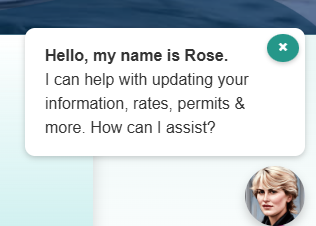
One contact email, yes. And we’ve just added “Rose,” our voice bot. When humans in our contact centre are busy, Rose answers calls. She’s handled things like backyard burning rules and fire bans. It’s been impressive.

Do callers adapt?

They do. Some ask for a human and get transferred. Others talk to Rose without realising she’s a bot - even though she says she is.

She uses a database I built that has a bunch of questions and answers. The AI finds the best answer, breaks it into steps, or combines answers. We’ve had great feedback, especially from customer service staff.

Abstract graphic showing four human icons inside circles, connected by lines, representing digital connection or networks.

Devenport City Council’s Rose chatbot is now a voice bot too.

What else are you working on?

An in-person version of Rose - a virtual avatar on a big screen that people can talk to. Very early days.

How do you balance using AI alongside staff retention?

Our customer service team actually loves the idea of not having to answer all those repetitive questions. And we have a shortage in customer service staff. So, it’s not necessarily about actively replacing staff, but if an AI can handle 40 calls at once for $60k a year, and someone retires, you might not need to replace them. You could invest more in training instead.

I'm going to almost guarantee some councils will use this to cut staff. But I strongly discourage it as it won’t necessarily make you very popular.

If we fast-forward 10 years, what will people laugh at about how we’re using AI today?

In 10 years time I am not sure if what we are doing now will be praised or we will be considered careless. I think It will be considered revolutionary, but we have already seen in the news the effects of not having strong guard rails and regulations on the use of AI.  

Any advice for people unsure where to start with AI or automation?

Start small. Look at repetitive processes that could be automated. You don’t need AI for everything - simple automation tools can do a lot.

Everyone wants AI, but we need to ask ourselves: do we actually need it? Is the thing the AI is doing worth that time and money? Or could the process be automated by something like Power Automate or Zapier? If it's processing emails, or building automated reports - you don't really need AI to do that.


That’s it for today’s edition - hope you enjoyed it.

If you think someone you know may enjoy this newsletter, please forward this on to them. Honestly, this is the best way you can support me to keep making these.

And as always, any feedback, please hit reply on this email and send it my way.

Have a great day, and see you soon 👋


The Risk Paradox: Why serious messages need less seriousness

Credibility doesn’t come from tone or language. It comes from consistency, and relevance.

 Read More 

Like what you’re reading but aren’t yet subscribed?

Don’t miss out on monthly content and social media tips delivered direct to your inbox.

 Sign me up! 
 

Coming to you from
Wairarapa
NZ

Unsubscribe

Seamus | Content strategy for councils and government