|
How Victoria Police manages 60 pages and 1000s of daily comments͏ ͏ ͏ ͏ ͏ ͏ ͏ ͏ ͏ ͏ ͏ ͏ ͏ ͏ ͏ ͏ ͏ ͏ ͏ ͏ ͏ ͏ ͏ ͏ ͏ ͏ ͏ ͏ ͏ ͏ ͏ ͏ ͏ ͏ ͏ ͏ ͏ ͏ ͏ ͏ ͏ ͏ ͏ ͏ ͏ ͏ ͏ ͏ ͏ ͏ ͏ ͏ ͏ ͏ ͏ ͏ ͏ ͏ ͏ ͏ ͏ ͏ ͏ ͏ ͏ ͏ ͏ ͏ ͏ ͏ ͏ ͏ ͏ ͏ ͏ ͏ ͏ ͏ ͏ ͏ ͏ ͏ ͏ ͏ ͏ ͏ ͏ ͏ ͏ ͏ ͏ ͏ ͏ ͏ ͏ ͏ ͏ ͏ ͏ ͏ ͏ ͏ ͏ ͏ ͏ ͏ ͏ ͏ ͏ ͏ ͏ ͏ ͏ ͏ ͏ ͏ ͏ ͏ ͏ ͏ ͏ ͏ ͏ ͏ ͏ ͏ ͏ ͏ ͏ ͏ ͏ ͏ ͏ ͏ ͏ ͏ ͏ ͏ ͏ ͏ ͏ ͏ ͏ ͏ ͏ ͏ ͏ ͏ ͏ ͏ ͏ ͏ ͏ ͏ ͏ ͏ ͏ ͏ ͏ ͏ ͏ ͏ ͏ ͏ ͏ ͏ ͏ ͏ ͏ ͏ ͏ ͏ ͏ ͏ ͏ ͏ ͏ ͏ ͏ ͏ ͏ ͏ ͏ ͏ ͏ ͏ ͏ ͏ ͏ ͏ ͏ ͏ ͏ ͏ ͏ ͏ ͏ ͏ ͏ ͏ ͏ ͏ ͏ ͏ ͏ ͏ ͏ ͏ ͏ ͏ ͏ ͏ ͏ ͏ ͏ ͏ ͏ ͏ ͏ ͏ ͏ ͏ ͏ ͏ ͏ ͏ ͏ ͏ ͏ ͏ ͏ ͏ ͏ ͏ ͏ ͏ ͏ ͏ ͏ ͏ ͏ ͏ ͏ ͏ ͏ ͏ ͏ ͏ ͏ ͏ ͏ ͏ ͏ ͏ ͏
|
Kia ora, I’ve been thinking a lot about trust lately - and how social media is one big ol’ game of trust. When people sign up to our channels they are placing trust in us to deliver what we say we will. We in turn are trying to boost public trust by sharing accurate information in a consistent and reliable way. And we engage transparently and genuinely to build connection and (you guessed it) trust. Where trust can break down, however, is in our own organisations, in the guise of sign-off or approval processes that are onerous or arbitrary. Because the people who best understand our social media audiences are the people who spend the most time with them - our social media advisors. And until we trust them to do the job we hired them to do, we’ll struggle to make much of an impact on our channels. In short: trust starts at home! If you’re attending next week’s Australian Public Sector Comms Week, you can come and see me talk all about trust. And if you’re based in Canberra, or attending the conference, get in touch. I’d love to meet for a chat. Cheers,
Seamus Boyer 👋
|
|
“Follower counts matter less than view and like counts. I understand why people focus so much on follower counts; they’re prominent and easy to find. But if you actually want to get a sense for how relevant an account is, look at how many likes they get per post and how many views per reel instead.” - Adam Mosseri
|
|
Disconnect for a while 🫳📱🚽
|
|
What a cracker of an interview I have for you today! Kendall Masters is the manager of the social media team at Victoria Police - a team that consistently impresses and delights with its content and comments. But more than that, they just seem to go about their business in a really, really deliberate way (which BTW is about the highest praise I can give). If you want to discover a clear strategy - read on. Kendall has a wonderful way of articulating the team’s approach in a super honest, engaging way. I also really like her thoughts on ‘the en-sh.tification of social content’ - why less effort can be more effective. I learned so much from this interview. Hope you do too. 👇👇👇
|
|
Firstly, Kendall, where do you work, and what do you do?
I manage the Victoria Police Social Media Team. We are a team of public servants and contrary to popular belief we are neither ‘interns’ or cops who ‘could be catching criminals’! I have previously worked in social media and strategic comms roles across both the South Australia and Victoria public service, including Health during the pandemic and the Department of Environment, Land, Water and Planning during the fires. You’ve been in government social media for a while now, describe how it has changed over that time?
I have worked in the public sector since 2016, and one of the biggest shifts I have seen in that time is the evolution of social media specialists as a full-time role in government agencies. In my initial forays into the industry, it was very much the norm to take on social as an additional responsibility. That said, I think having a strategic comms background has been incredibly beneficial for me in terms of translating social media into corporate comms parlance and embedding structure into what we do (aka demonstrating how the fun stuff supports the strategic). That is a skillset I try to pass onto my team now, so they are prepared to operate in other roles and other areas.
|
|
|
Kendall Masters manages the Victoria Police Social Media Team. |
|
|
How would you summarise what your channels are for? What is Victoria Police trying to achieve on social media?
Our priorities are: Building the channels to mobilise in an emergency Building trust in the institution and humanising the people behind the badge so that people feel safe in their relationship with police Leveraging the platforms to a) ensure people are aware of the services we provide and b) help with operation objectives (aka solving crime) Enhancing perceptions of safety by giving visibility to the outcomes of police work.
There is a perception among some people that the organisation uses social media for ‘reputation rehab’ or ‘copaganda’, which just isn’t the case. Social media is far too polarised for that, so it is fair to say that reputation is not a major priority area for us. What’s your team set-up?
My team work a shift roster across 7 days and extended hours, to cover reactive tasks like moderation, missing people, emergencies, and livestreaming stand-ups. We have two portfolio managers who loosely cover proactive (eg. Priority Communities, Recruitment, Campaigns) and reactive commands (Road Policing, Regions) from a strategic/project management perspective. The rest of the team cover a shift roster doing the legwork in the reactive sphere, taking on more discrete strategic projects, and managing regional content.
How many channels are you in charge of? I notice there are a lot of Eyewatch Facebook pages on your website - who manages those?
We have around 60 pages that we manage in varying ways. The 54 Eyewatch pages are partially populated by coordinators embedded in the regions (generally sworn members), but my team take care of the governance, strategic messaging and some reactive messaging for them, which is often a very big job! Briefly describe what you use your various channels for - they are noticeably different in content and tone. Facebook: A bit of everything! Eyewatch: A bit of everything (but make it region-specific) Instagram: In feed: Mostly evergreen proactive messaging, with a sprinkle of celebrating the work of police and the warm and fuzzy moments. Stories: Top-level reactive updates, Q&As. Always with statewide relevance.
LinkedIn: Acknowledging staff achievements, recruitment messaging (particularly directed at career changers), content about policies and pilot projects, celebrating good work. TikTok: Exclusively for content directed at under 25s with a focus on pillars of content relevant to that cohort – road safety, bodily autonomy, public safety, cyber safety, and early career recruitment. Very much a focus on entertainment-first content. X: Posting media releases – essentially maintaining it in a holding pattern for deployment in an emergency.
|
|
|
Victoria Police publishes and moderates an astonishing amount (and variety) of content across its channels. |
|
|
How do you reflect the work of such a big and broad organisation without diluting your messages?
With great difficulty! In particular there is always tension between using the channels to engage proactively with the community vs using them for operational purposes vs accurately demonstrating the role of police vs ensuring we showcase the outcomes of good policing. The great thing about it is we do have access to a great deal of variety in our content which I think is a real asset in social media. There is a deep well of stories in this organisation - if we had all the resources in the world, and all we worked on was proactive stories, I still don’t think we’d reach the bottom. How much of the content is generated by the organisation as part of BAU, and how much is your team proactively creating? How do you balance the proactive with the reactive?
This is a very sharp question, and the answer is complex! We are super lucky to get:
- great imagery and video from other parts of our department
- excellent stories and informal ‘on the job’ images from the regions
- great stories from Police Life (biannual magazine)
- news stories coming from left, right and centre – much of which has a high level of public interest.
In all instances my team are responsible for repackaging this BAU content into social media stories. I suppose the TL;DR is there is very, very, very little posted on our corporate channels that would come wholesale from other parts of the organisation as part of BAU, without being social-ified. If I were to affix an arbitrary measure on it, I would say about 90% of proactive content is driven by the team from start to finish, as opposed to sourced elsewhere and repackaged. Where the opposite ratio is true of reactive content.
For us, reactive will always take precedence because ultimately that is our core business. We have worked hard to create efficiencies to make it more manageable and impactful by being selective and strategic when it comes to the how, when and where we highlight reactive messaging.
|
|
Does your team create everything, or do officers and other people in the organisation make their own content (ie TikToks)? If so, how do you manage that process and maintain quality standards?
I’ll start with the second part of your question because it is a key component of my social media philosophy. Regarding the concept of ‘Maintaining quality standards’: I am extremely pro the ‘en-sh.tification’ of social content. We consistently find that effort and success have an almost perfect negative correlation when it comes to our social media assets. Less (effort), is often more (effective).
I encourage my team to pursue their passion projects, but to me the effort that goes into carefully constructing and socialising an idea is often better spent finding a creative (and simple) way to approach a message or, failing that, a few different ways to see what lands.
Video content on our channels is generally entirely generated by our team. We are also dabbling in getting police members to film ‘day in the life’ content with an iPhone, which has worked really well. I would love to empower more of them to supply content and ideas but unfortunately, for very valid and important reasons, they are often steered away from engaging with social media quite early in their training and it does take a bit of convincing sometimes.
I read that you can receive up to 3,000 comments, messages and mentions in a day - how on earth do you triage those in terms of knowing what to reply to and what to ignore?
3000 incoming messages certainly does happen on a bad day, and that will often be driven by mentions about an issue we are only tangentially related to. Mentions are a constant thorn in our side. Truthfully, we get very little value from engaging with mentions, so the easiest place to start when things kick off is to filter them out and concentrate on the areas we can constructively engage with.
I can also see why many agencies and businesses are moving away from X – there is very little productive engagement happening there. But as we saw again with the NSW Bondi incident, in an emergency it is vital – and at the end of the day that is our core business.
Most of the time if we filter out mentions plus turn off comments when we know they’ll get hairy, that’s enough to get moderation to a manageable point with a few extra pairs of hands helping out.
|
|
|
|
Another classic post from Victoria Police which gained 43k likes on Facebook alone and a lot of positive media coverage. |
|
|
|
You’ve rightfully had some big wins in the comments section, but a lot of organisations miss these opportunities either through risk aversion or being too slow. What’s your process for quickly responding in humorous and creative ways?
We have a handful of proactive content pillars which are always on - recruitment, online reporting, road safety etc. The team are extremely familiar with the messaging for these, so they feel very comfortable leveraging opportunities to weave them into a response. If they’re feeling like it might be on the nose, they drop it in the chat to gauge everyone’s thoughts.
One thing about people who moderate in an organisation like this one is they fairly quickly build an acute awareness of, a) contentious issues, and b) how content or messaging will be received. They see the comments every day, so I think they are extremely well placed to evaluate the risks presented in a comment section. The struggle is more often getting the motivation to wade through all the negativity to recognise where the opportunities lie. Do you set out to get media attention with some of your more creative posts? Or is that just a byproduct?
Never intentional! Truly if we were courting that sort of attention, we’d use X in a more proactive capacity for content! Often that is where the media will pick up on a fairly innocuous post since journos are traditionally a fairly active cohort there. Our organisation is supported by a very proactive media unit who have very productive relationships with traditional media – I don’t see our role as playing in that space. How often do you get it wrong?
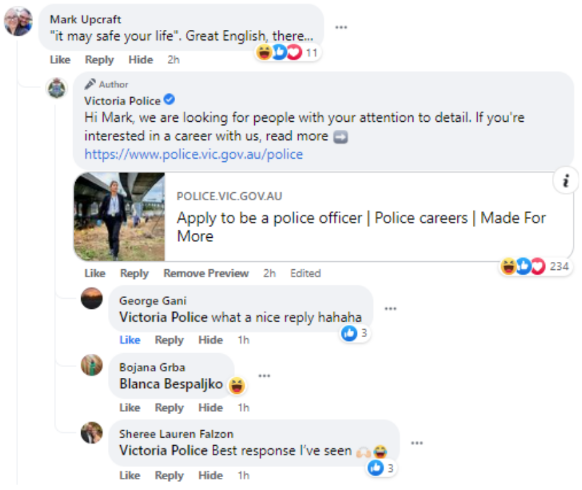
Typos? Every day. The speed with which we process content, and the volume we process, make minor errors inevitable. I encourage the team to take ownership of errors which don’t impact the comprehension of the message, and lean into it with a bit of banter in the comments (e.g. asking them if they have considered a career as a detective). Sometimes the stakes are a bit higher! We had a very unfortunate incident recently where a combination of human error and our moderation software resulted in an accidental retweet regarding a very sensitive subject. While we rectified the issue withing 3 minutes, the screenshots sure haunted us for much longer. In that instance it was necessary to publicly acknowledge the issue – regardless of whether anyone took it on board…
|
|
|
|
Even typos are an opportunity to get those key messages across… |
|
|
|
No doubt you will be exposed to some sad, violent, and tragic moments as part of your work. How do you deal with that?
We have put in a lot of work to limit the channels where this sort of content would enter my team’s orbit. In the past, direct messages were a channel where it was very easy for us to end up in confronting situations, but we did make the decision to turn off DMs some time ago as they were essentially providing an easy out for people looking to avoid the proper channels. As a team we are very supportive, and we laugh a lot. If we didn’t take the time to enjoy the light moments, I think the pull of the dark would be much stronger! We also have access to the same support services as frontline members, including extensive access to wellbeing support services.
How do you measure success for you and your team?
For me:
Are the team engaged and interested? Are they learning and developing? I think it is my job to ensure that they are getting something from the role, and ensure that I am positioning them well for their next one. I’m not interested in creating lifers – I want people who love to learn, and who might navigate away and then come back with new skills and insight. If I was asked tomorrow to demonstrate how we have met business objectives over the last x months, could I? How prepared are we for shifts in the industry? Do we have strategies in place to fall back on? Are we considering how we can leverage new tools and opportunities? Are the team being strategic in how they approach outputs and building relationships? Are we deploying our resources in the most impactful way? Do they feel empowered to give frank and honest feedback and advice to their peers (and to me!)
For the team: Are we analysing and reflecting on what is working and not working – and adjusting accordingly? Are we adequately servicing key priority areas? Are we building productive relationships with other areas of the department and organisation? Can we articulate our purpose and the strategy behind our output?
And finally, what are you most proud of in your work?
My delightful team! I have had the absolute pleasure of watching them all grow and become more strategic, creative and autonomous with every passing week. I say all the time, they are the heartbeat of this team and I truly feel like I am the least relevant member. They are all stars, and they make coming to work an absolute joy.
|
Quick 6 with Kendall Masters… 1. Strategy or tactics?
Depends on what you want to achieve, and whether you are managing up or down. I think having a well-defined strategy helps manage up and contextualise how activity fits into the bigger picture. Tactics are the spaghetti you are throwing at the wall to execute the strategy, and they have more impact on a day-to-day basis for the team and our work.
2. Favourite platform? TikTok every day of the week (pls don’t take it away from me).
3. Least favourite platform?
This is hard because I hate elements of them all at this point, specifically: - Instagram Reels (where fun content goes to die … extremely slowly)
- Meta Business suite (where previously useful tools and info go to bug into oblivion … extremely quickly)
- Almost everyone who actively uses X. 4. One public sector account to follow?
The US Consumer Product Safety Commission – unhinged brilliance.
5. One non-public sector account to follow?
Sylvanian Family Drama on TikTok (for absolutely no reason).
6. Something you wish you’d known earlier in your career? The opportunities you miss will open the door to others that will much better serve you and you’ll be glad about how things panned out in the end.
|
|
That’s it for this edition. Thanks for reading. As always, please consider sharing this newsletter with someone you think might get value from it. Or hit reply and share some feedback with me - I love hearing from you! Oh, and if you made it this far, here’s a social media joke courtesy of ChatGPT: Q: What’s a social media addict’s favorite dessert? A: Hashtag brownies. See you in two weeks for more tips on how to get a little bit Better 👋
|

|
Nelson City Council’s new approach to limiting comments on social media is understandable but misses the mark. Effective engagement requires more resources, not less conversation. |
|
|
|
Like what you’re reading but aren’t yet subscribed? Don’t miss out on monthly content and social media tips delivered direct to your inbox.
|
|
|
|