|
Practical tips and tricks͏ ͏ ͏ ͏ ͏ ͏ ͏ ͏ ͏ ͏ ͏ ͏ ͏ ͏ ͏ ͏ ͏ ͏ ͏ ͏ ͏ ͏ ͏ ͏ ͏ ͏ ͏ ͏ ͏ ͏ ͏ ͏ ͏ ͏ ͏ ͏ ͏ ͏ ͏ ͏ ͏ ͏ ͏ ͏ ͏ ͏ ͏ ͏ ͏ ͏ ͏ ͏ ͏ ͏ ͏ ͏ ͏ ͏ ͏ ͏ ͏ ͏ ͏ ͏ ͏ ͏ ͏ ͏ ͏ ͏ ͏ ͏ ͏ ͏ ͏ ͏ ͏ ͏ ͏ ͏ ͏ ͏ ͏ ͏ ͏ ͏ ͏ ͏ ͏ ͏ ͏ ͏ ͏ ͏ ͏ ͏ ͏ ͏ ͏ ͏ ͏ ͏ ͏ ͏ ͏ ͏ ͏ ͏ ͏ ͏ ͏ ͏ ͏ ͏ ͏ ͏ ͏ ͏ ͏ ͏ ͏ ͏ ͏ ͏ ͏ ͏ ͏ ͏ ͏ ͏ ͏ ͏ ͏ ͏ ͏ ͏ ͏ ͏ ͏ ͏ ͏ ͏ ͏ ͏ ͏ ͏ ͏ ͏ ͏ ͏ ͏ ͏ ͏ ͏ ͏ ͏ ͏ ͏ ͏ ͏ ͏ ͏ ͏ ͏ ͏ ͏ ͏ ͏ ͏ ͏ ͏ ͏ ͏ ͏ ͏ ͏ ͏ ͏ ͏ ͏ ͏ ͏ ͏ ͏ ͏ ͏ ͏ ͏ ͏ ͏ ͏ ͏ ͏ ͏ ͏ ͏ ͏ ͏ ͏ ͏ ͏ ͏ ͏ ͏ ͏ ͏ ͏ ͏ ͏ ͏ ͏ ͏ ͏ ͏ ͏ ͏ ͏ ͏ ͏ ͏ ͏ ͏ ͏ ͏ ͏ ͏ ͏ ͏ ͏ ͏ ͏ ͏ ͏ ͏ ͏ ͏ ͏ ͏ ͏ ͏ ͏ ͏ ͏ ͏ ͏ ͏ ͏ ͏ ͏ ͏ ͏ ͏ ͏ ͏ ͏
|
Hello! I’ve never been an early adopter of technology. It took me a long time to get a mobile phone, social media accounts, smart phone etc. I did, however, jump pretty quickly onto the AI bandwagon, and try and keep up with developments. It’s too important not to, I reckon. I don’t use AI for everything, or even most things (there are so many unnecessary AI tools and applications out there). But I do use it often for the things that I can’t do or get elsewhere. For example, I often use ChatGPT and Claude for testing theories or picking holes in my arguments. As a solo operator I don’t often have people around to bounce my ideas off, and these tools are very good at instantly providing a wide range of counter arguments to help me improve my thinking. One thing I don’t use AI for is writing. My posts, articles, newsletters and other work are 100% me (for better or worse). So feel free to run this through whatever detection tool you like - I guarantee it’ll pass 😉 Cheers,
Seamus Boyer 👋
|
|
“Nobody is better than you. You might be young, or new to the field, or have a particular current limitation. But the people you look up to were once sitting in the same seat you are now. There’s no reason you can’t mix what you learn from them with your own special strengths and create your own successful path” - Michael Smart
|
|
I’m hosting a Christmas party and quiz on 12 December in Wellington. Details are over on my LinkedIn page. Come along! 🧑🎄🎄
|
|
Sing someone’s praises. You can’t go wrong.
|
|
I first saw Zack Seipert at Public Sector Comms Week in Canberra earlier this year. Beaming in from his home in Utah, USA, he was speaking about AI, and his presentation was warm, funny, and super practical. I then saw him again present virtually at a social media conference in Wellington, and this time he had a full hour to give even more practical tips. It was bloody impressive - so much so I had to get in touch with him to talk some more. P.S. It will be obvious, but just spelling out that I got ChatGPT to create images for this edition 🥴 👇👇👇
|
|
Firstly, Zack, where do you work, and what do you do? I am the marketing and communications specialist at the Central Utah Water Conservancy District. Here, I am over our organisation's social media presence, media relations, and a variety of other things.
But before entering public service, I was employed by a local marketing and advertising agency that specialised in tourism marketing, fresh out of college/university (and fresh out of the COVID-19 pandemic). You can imagine how tough it was trying to market tourism, destinations, and vacations at a time when many people were so fearful.
After my short stint with this agency, I was looking for a job, or perhaps a career, that carried more meaning. One where I could truly help people and use my skillsets for good instead of stuffing my prior boss’s pockets. That’s when I was made aware of a job opening at a government organisation that I didn’t even know existed, the Central Utah Water Conservancy District.
Fast forward nearly four years and here I am today still as happy as I was when I first accepted the job.
|
|
|
|
This image of Zack Seipert is real! And you can subscribe to his newsletter by visiting his website. |
|
|
|
Let’s start with a quick definition of AI - what exactly are we talking about here?
AI, or artificial intelligence is the science and study of creating systems or machines capable of performing tasks that would normally require human-level intelligence. AI in one form or another has existed since the 1950s when researchers and scientists built an algorithm that could play chess. Advancements in this field quickly have become part of our everyday life in the form of reCaptcha image tests, social media algorithms, and suggested YouTube videos just to name a few.
The recent boom in AI research and development has been around a branch of AI called Generative AI. The difference between the older AI programs and algorithms, and the ones we see today from OpenAI, Google, Meta, etc. is that the AI has now been trained on enough data, and can make inferences with much higher accuracy, that it can now generate, or create, content.
Text, images, music, podcasts, and videos can now all be created by AI with no computer code at all. How much of a gamechanger do you think AI is or will be for public sector social media? This is an interesting question. The two thoughts I have on this subject are: AI is the great equaliser, and AI will drive the desire for more human content.
First, AI is the great equaliser. For many public sector or government communications teams, our access to resources rarely stacks up with private sector companies. We often don’t have the staff we need, can’t afford the tools and technology we desire, and yet the public expects the same level of customer service and experience from their government as they do elsewhere.
AI now levels the playing field. For roughly $20 a month, we have access to the same AI technology as some of the biggest companies in the world. With this technology, we can now be more productive than ever before. We don’t have to be an expert in copywriting, graphic design, videography etc. That in and of itself is something that gets me excited.
On the flip side is the thought that if the web and social media are flooded with AI-generated content then the desire for more human content will arise. People will overlook the polished, perfect pixels and desire the human-to-human connection.
I feel that we as government and public sector communicators are uniquely positioned to capitalise on that need and desire for human content. We are arguably closer to those we serve than any other line of work. The more human we are in all that we do, the more the public will trust us and our organisations.
|
|
|
|
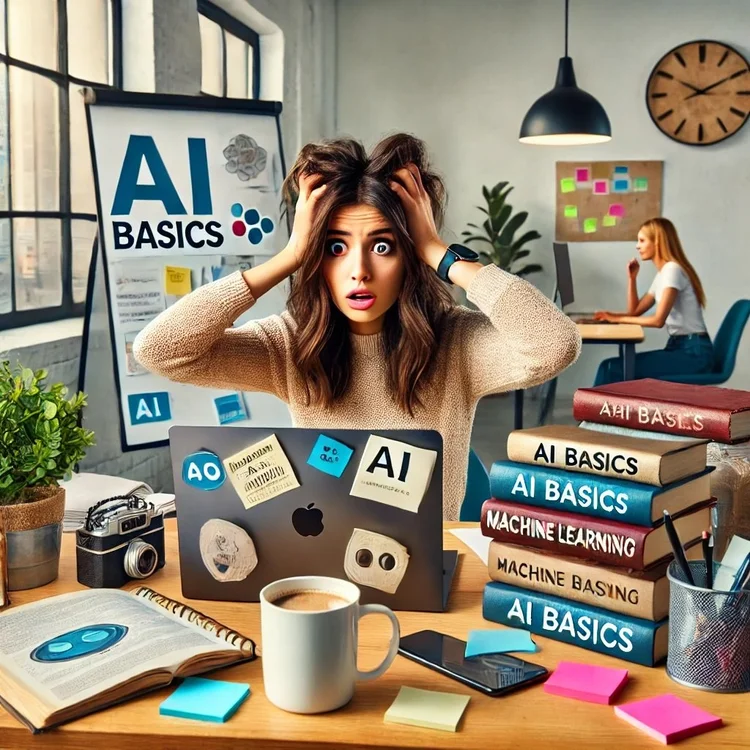
ChatGPT’s image of a frazzled social media advisor who doesn’t use AI. Slightly terrifying. |
|
|
|
What are some of the tools you use? I am an early adopter of ChatGPT and have stuck with that AI tool despite many more tools now offering similar services (Google Gemini, Microsoft Copilot, etc.). It’s by far the tool I’m most familiar with, but I make it a habit to try and test different tools as they come out or make improvements.
My go-to AI tools as of writing this are:
ChatGPT Canva Adobe Creative Cloud Perplexity Opus Clip
The space seems like it’s constantly evolving, how can people stay up to date with new tools and software?
You’re 100% correct. This stuff moves FAST. I would be lying to you if I said I myself am caught up on all the major AI developments and releases. There is just no way to stay up on this technology by one’s self. It’s impossible.
That’s why its so important to have resources, a community, or experts you can turn to and follow. Here are a variety of sources that I turn to in order to stay as up-to-date as possible on the AI space.
A few of my favorites are:
|
|
|
|
AI helps social media advisors to ‘muttask’, whatever that is. |
|
|
|
At the moment it feels a little like the wild west in terms of how organisations are using AI. How can we start to formalise what our AI usage looks like? I can’t stress this enough. You NEED some form of AI guidelines or policy in place at your organization. Period. Don’t be naive thinking no one is using these tools or is aware of all the potential privacy and security risks associated with using these tools.
I always direct people to this link when they ask about good examples of AI guidelines or policies. The page has a good number of policies from local, state, and federal agencies.
Here are some questions to consider when drafting your organisation’s AI guidelines or policy: Are employees allowed to use AI (text / image / video / audio) tools to generate (external / internal) content? Which tools are they permitted to use? Do employees have to disclose their use of AI in final outputs for (external / internal) audiences? What are the legal, privacy, data, and security risks?
Wise advice from the Marketing AI Institute is to set up an AI council at your organisation. A diverse group of volunteers perhaps interested in, or affected by the technology, men and women, across departments, and with varying levels in the organisation. Meet and discuss recent developments, new risks or concerns, and vet or develop tools and technology.
What are the biggest challenges that you hear from government communicators when it comes to adopting AI in social media? How can we overcome them?
I think the number one fear I hear time and time again is regarding privacy and security. A close second would be the issue of potentially losing trust.
Privacy and security are real, valid concerns. These tools by default have a lot of their ‘safety and security’ features turned off by default. This allows the AI companies to use the information you put into the tools as part of their future databases and in the training of their future models. So you’ll want to make sure that any and all employees that use or have access to these tools are aware of that.
The concern of losing trust with the public and those you serve I find to be an interesting one. And it stems from the fear that if we use AI in our final piece of content the public will notice and trust us less for doing so.
Not all the benefits to be gained from AI technology have to be in the form of content creation. There are huge productivity gains that can be made in internal communications, video editing, writing press release drafts, etc. It's about using AI as an amplifier, not a cure-all solution.
|
|
|
|
This is how AI imagines you will feel after you complete your AI policy. Which you will of course create with a pencil and paper. |
|
|
|
Are there any particular issues that government communicators need to think about?
Again, I would be extra cautious when it comes to data privacy and security. As government employees, we often have access to proprietary information that should stay that way. We wouldn’t want to upload an Excel spreadsheet with email addresses or social security numbers (IRD numbers) for example. I encourage people to always exercise caution and when in doubt play it safe.
A lot of government organisations have very small teams - how can we use AI tools to save us time?
That is one thing AI is really good at. It can be an amplifier and a time saver. I would suggest that you look at your job as a collection of tasks. What tasks do you do each and every day? Week? Month? Year?
Then once you have a list of tasks that you perform regularly I would look at that list through the lens of this framework from Trust Insights, which helps you see which tasks you could begin to incorporate AI into.
T - Time - How much time does the task consume? The more time a task consumes, the better a candidate it is to incorporate AI.
R - Repetition - How repetitive is the task? AI excels at repetitive tasks. The more frequently repetitive a task, the better a candidate it is to incorporate AI.
I - Importance - How important is the task? How much risk is there if it goes awry? The more important a task is, the more human review is needed. Tasks that are low-risk or relatively low in importance are great candidates for AI.
P - Pleasantness - How much do you enjoy the task? The less you enjoy a task, the better a candidate to incorporate AI. This is critical for stakeholder buy-in, showing stakeholders they can offload unpleasant tasks is high emotional value.
S - Sufficient Data - How many existing examples do you have of the task and how it’s supposed to be done? The more examples you have of how the task should be done, the better a candidate it is to incorporate AI. If it’s a template today, AI should do it tomorrow.
Let’s walk through an example. Let’s say one of your tasks is to edit reels for your organisation’s Instagram account.
T - Time - Editing a reel generally takes 1-2 hrs.
R - Repetition - We post 2 reels a week.
I - Importance - It can range in importance based on the topic of the reel.
P - Pleasantness - I really enjoy editing video, but do acknowledge it takes up a lot of my time.
S - Sufficient Data - No real template or data for reels as they are each unique.
This could potentially be a task that you could infuse some AI into. Premiere Pro, Opus Clip, Canva, etc.
Is there any good free or cheap online training that you know of? Yes! I’ll share with you a few resources that really helped me. The Marketing AI Institute has a variety of AI education/training options (Free Intro to AI class): https://www.marketingaiinstitute.com/education
Mark Schaefer, one of my absolute favorite marketers has a wonderful community on Discord where we discuss the future of marketing and communications. You can join, and try out the community for free for the first 3-months. This community has members around the globe who work in every industry imaginable: https://businessesgrow.com/rise-community/
I’d also be more than happy to offer an Intro to AI webinar to any interested parties. Feel free to contact me via my website.
|
|
|
|
An AI image of a social media advisor learning about AI. Note the old school camera for some reason. |
|
|
|
When do we need to disclose that we’re using AI tools? Is it just when we generate content?
Transparency about AI usage doesn’t have to mean tagging every single interaction or output. Instead, it’s about finding a balanced, practical approach to disclosure. I think what it boils down to is personal or organisational morals and ethics.
For example, do we disclose that we use spelling and grammar check or Grammarly when we write? Do we disclose that we use a calculator when doing math? Of course not. Not every situation will warrant a stamp, badge, or icon stating this content was 100% human-made. I would encourage you to be proactive and not reactive in your disclosure of using these tools should the situation warrant it. Ultimately, proactive disclosure should be based on the impact AI has on the final output, guided by a sense of trust and integrity rather than by a rote application of a disclosure policy.
In public sector communications especially, staying transparent when AI has played a substantial role in crafting key messages helps maintain trust. However, over-disclosing for minor applications could dilute the importance of disclosures themselves. I would say we should focus on being intentional and, whenever we’re unsure, consider if disclosing AI’s involvement would add value or clarity for our audience. Let that guide your decision to disclose.
Can you use AI for data analysis and reporting?
Sure can! Go ahead and give this prompt a try in ChatGPT (you will need to download some recent Instagram/Facebook data from your organisation’s Meta Business Suite account beforehand):
“Today we are going to analyse some Instagram data. What do you know about successful accounts on Instagram?” (This is called priming the model. We are essentially defining and narrowing the context of our conversation.)
(Review the AI’s response, checking for any oddities of hallucinations)
“Based on the Instagram/Facebook data I provided please analyse the data to determine: The times I posted content that received the most engagement The type of content that was most engaging Which captions seemed to receive the most engagement - long or short Provide 10 suggestions on how we can improve our content Develop a 2-week posting schedule based on your analysis of the provided data and provide it in a table format with the columns being: Day, Time, Content Type, Content Topic Idea”
(Upload your Instagram/Facebook data that you’ve downloaded from Meta Business Suite) You’ve just analysed your social media data and insights using ChatGPT!
|
|
|
|
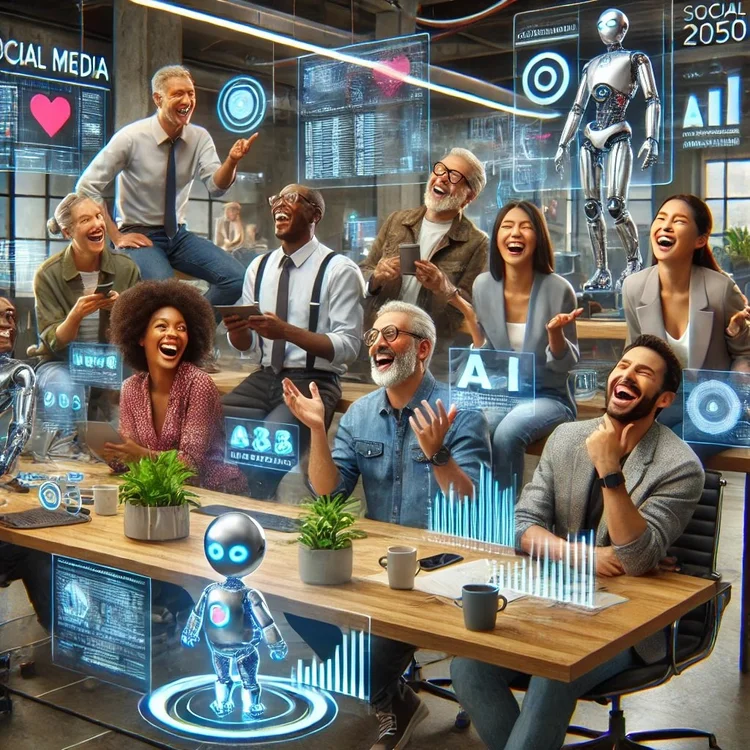
ChatGPT says this is what a government social media team will look like in 2050. Plenty of lols apparently. |
|
|
|
What might an AI-mature comms or social media team look like? It is very difficult to look into the crystal ball and predict what the future holds, especially with a technology that is moving so quickly and has yet to see much regulation.
One thing that I do foresee happening is that AI-mature comms or social media teams will consist of far fewer specialists, and more generalists. What I mean by this is that many marketing/comms teams are siloed (i.e. SEO specialist, Google Ads Specialist, Meta Ads, etc).
With AI, anyone who knows a little bit about the subject matter and how to prompt or work with an AI application can immediately become competent. Competency is not enough anymore. I believe curiosity and creativity will be some of the most important skillsets moving forward.
How do you see AI reshaping the future of social media management in the public sector over the next 5-10 years? What should government communications teams be preparing for now?
If you’ve been dismissing this technology up until this point, I implore you to stop. You need to be informed. You need to be aware. You need to experiment. This technology is already beginning to weave its way into every product, tool, service, and offering available.
You need to take control of your future and begin learning about and experimenting with this tech. Start small with simple exercises or prompts. Then you can begin to really push the boundaries of what is possible and see where these tools can truly help you in your career and life.
|
Quick 6 with Zack Seipert… 1. Strategy or tactics?
Strategy is very important, but I would argue that the ability to pivot and adjust one’s tactics is nearly as important nowadays. We need to be nimble.
2. Favourite platform? As of late, I’m really enjoying LinkedIn and a close second would be YouTube.
3. Least favourite platform?
I have never enjoyed Twitter/X. It has its place in my social media toolbelt, but personally, I’m not a big fan.
4. One public sector account to follow?
Being in the water space, I have to shout out a fellow water organisation. The Northeast Ohio Regional Sewer District is who I aspire to be. (Their Twitter/X account is the best!)
5. One non-public sector account to follow?
The Savannah Bananas are a must-follow in my opinion. They are on a mission to “Make Baseball Fun.” The owner Jesse Cole is also a true visionary!
6. Something you wish you’d known earlier in your career? Be the mentor you wish you had. Pay it forward.
|
|
That’s it for this edition. Please consider sharing it with someone you think might get value from it. And hit reply and say gidday! I love hearing from readers, so go on, introduce yourself! See you in two weeks for more tips on how to get a little bit Better 👋
|

|
Excessive 'family Facebook' content can hinder your organisation's online presence. Here’s how to avoid it. |
|
|
|
Like what you’re reading but aren’t yet subscribed? Don’t miss out on monthly content and social media tips delivered direct to your inbox.
|
|
|
|