|
Giant cats, lamprey, and …. Old Gregg?! ͏ ͏ ͏ ͏ ͏ ͏ ͏ ͏ ͏ ͏ ͏ ͏ ͏ ͏ ͏ ͏ ͏ ͏ ͏ ͏ ͏ ͏ ͏ ͏ ͏ ͏ ͏ ͏ ͏ ͏ ͏ ͏ ͏ ͏ ͏ ͏ ͏ ͏ ͏ ͏ ͏ ͏ ͏ ͏ ͏ ͏ ͏ ͏ ͏ ͏ ͏ ͏ ͏ ͏ ͏ ͏ ͏ ͏ ͏ ͏ ͏ ͏ ͏ ͏ ͏ ͏ ͏ ͏ ͏ ͏ ͏ ͏ ͏ ͏ ͏ ͏ ͏ ͏ ͏ ͏ ͏ ͏ ͏ ͏ ͏ ͏ ͏ ͏ ͏ ͏ ͏ ͏ ͏ ͏ ͏ ͏ ͏ ͏ ͏ ͏ ͏ ͏ ͏ ͏ ͏ ͏ ͏ ͏ ͏ ͏ ͏ ͏ ͏ ͏ ͏ ͏ ͏ ͏ ͏ ͏ ͏ ͏ ͏ ͏ ͏ ͏ ͏ ͏ ͏ ͏ ͏ ͏ ͏ ͏ ͏ ͏ ͏ ͏ ͏ ͏ ͏ ͏ ͏ ͏ ͏ ͏ ͏ ͏ ͏ ͏ ͏ ͏ ͏ ͏ ͏ ͏ ͏ ͏ ͏ ͏ ͏ ͏ ͏ ͏ ͏ ͏ ͏ ͏ ͏ ͏ ͏ ͏ ͏ ͏ ͏ ͏ ͏ ͏ ͏ ͏ ͏ ͏ ͏ ͏ ͏ ͏ ͏ ͏ ͏ ͏ ͏ ͏ ͏ ͏ ͏ ͏ ͏ ͏ ͏ ͏ ͏ ͏ ͏ ͏ ͏ ͏ ͏ ͏ ͏ ͏ ͏ ͏ ͏ ͏ ͏ ͏ ͏ ͏ ͏ ͏ ͏ ͏ ͏ ͏ ͏ ͏ ͏ ͏ ͏ ͏ ͏ ͏ ͏ ͏ ͏ ͏ ͏ ͏ ͏ ͏ ͏ ͏ ͏ ͏ ͏ ͏ ͏ ͏ ͏ ͏ ͏ ͏ ͏ ͏ ͏
|
Hello there friend, I hear a LOT from people who want to stop doing various types of content on their socials. Stop posting every little event, every last consultation, all the tick-box stuff that gets done because it’s always been done. The problem is they can't always clearly describe what they'd do instead. ‘We’d have more time to be creative’, ‘we’d shoot more video’, ‘we’d be more strategic’ - this is vague, waffly stuff that is easy to ignore. A wonderful way to fight being terminally reactive is with an irresistible vision of what a more proactive and effective alternative looks like. People find it much easier to let go of the old when they can see exactly where they might be heading instead. Which might mean doing the work to articulate that new future, then mocking it up with a bunch of examples to bring it all to life. So sell the vision, in detail, and people are much more likely to get onboard. Speaking of which… I have some availability coming up in July and August - if you’ve been thinking of getting some outside perspective to solve a problem or make the most of an opportunity, get in touch. Maybe you'd like to: Get your team on the same page Build a stronger organisational narrative Improve measurement and reporting Get more of your people active (and effective) on LinkedIn Prepare for change
What's one thing you'd like to finally solve? Let me know. Cheers,
Seamus Boyer 👋
|
|
“Instead of talking through different solutions to work out which is best, take it out of the realm of the verbal. To truly weigh choices, it’s necessary to bring them into the physical world. Have them acted out, played out, or built into a model. Descriptions do not do ideas justice.” - Rick Rubin
|
|
In terms of govt social media greats, Chris Gaylord is one of the OGs. He was doing awesome, funny stuff back when public sector socials all looked like … well, you know very well how they looked. Chris is the one-person social media team who made the Portland District of the US Army Corps of Engineers channels famous - and he’s been doing his wonderful unique thing for 7 years now. The content is truly original, funny and surprising, but it also has such solid strategic foundations. Which means it has generated both huge internal support, as well as a cult following externally (it’s also one of the most frequently cited channels by other govt social media pros). I really enjoyed talking to Chris for this edition - as a fan of his work, but also because he’s just a bloody nice, quiet, humble dude. Enjoy. 👇👇👇
|
|
Firstly, Chris, can you explain who you work for please? Because it’s not common here in New Zealand and Australia. What are you? A soldier? What are any of us, really? [laughs]. So I work for the US Army Corps of Engineers, which falls under the Department of Defense. I work in our public affairs office as a one-person social media team, which isn't super uncommon. I'm technically an Army civilian - you don't have to have served in the military to work for us. We're kind of like the federal government's engineering agency. We always say we handle the nation's toughest challenges. We've actually been around since 1775 - George Washington appointed a couple of the first army engineers, that's what we trace our roots back to.
Here in Portland we're one of the largest and most diverse civil works districts across the whole Corps. We have systems of dams that reduce flooding for communities in central and southern Oregon. We have navigation locks and dredges and jetties that all work in concert to help more than $25 billion of commerce move through the Columbia Snake River system annually. We also respond to emergencies - Mount St. Helens was a really good example, we were one of the leading agencies to respond to the aftermath.
|
|
|
|
Chris Gaylord helps keeps Portland both weird and engineered. |
|
|
|
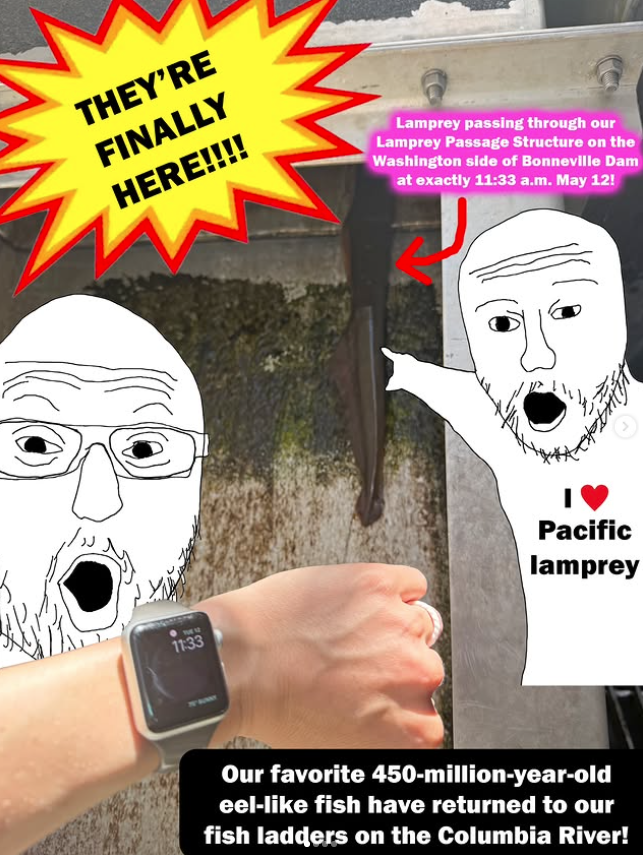
Why does an organisation like yours need social media? It's a good question, because it's not like we're a brand - we're not a profit-maximising organisation or anything like that. But we do all this really important work, and people just aren't really aware of us. So for us as public servants, what it really comes down to is transparency and public trust, and keeping our publics informed. And really, what's the best way to do that in real time? Meeting them in the space where most folks who live in the communities where our work takes place are hanging out on a day-to-day basis. Facebook, Instagram, X. It's not typically sexy work. Which I actually think can give you advantages - because you have to work harder for attention, right? Exactly. And that's why we employ so much humor - because for us humor is a gateway to the message. It's a way to create scroll-stopping moments, as they say. The battle for attention is already tough no matter what kind of organisation you are, but for us - nobody's like, ‘what's going on with Bonneville Dam? What's up with that concrete structure stretching across the river?’ No one's really thinking about us. The way I often put it is: we can't take it for granted that anyone's going to care what we have to say. Humor isn't us making fun of the things we communicate about - it's a delivery method, it's adapting to the communication landscape. Your channels are super famous for your use of humour - how did you get there? Because I'm looking at a crazy lamprey post, a giant cat post, Old Gregg, this stuff is pretty out there. I assume you didn't walk in on day one and do this? No, that's correct. So I arrived at the Corps right at the same time as my boss, and we were the only two on the team who had private sector experience. My boss restructured the team so that everybody specialised more like a private sector marketing communications office, rather than all being generalists.
|
|
And so, for a time, I was doing our employee comms programme and our social media programme, in addition to a lot of other stuff, and oddly enough, we were putting in water bottle fill stations in our headquarters building, and I was like, ‘What if we just had some fun with it? What if we did a meme?’ My boss said, ‘go ahead, show me what you've got’. I showed him the meme, and he said ‘okay, go put it on the intranet’. So we put it on the intranet, and we did it a few more times, and people started telling us - ‘I've never read our intranet before, now I'm actually reading the content. Keep it up’. A couple of months later I went to a coffee shop with a teammate and we just brainstormed a bunch of funny ideas for social. It was around the holidays, so we did a twist on Elf on a Shelf - it was Yams on Dams. It was stupid [laughs]. I mean it wasn't even really educational, it was just kind of more of the social end of social media, which is important too. And it took off, it was kind of the jumping point, and we never really looked back. A lot of what went into it was just knowing what I like to see on social media. I follow breweries and meme pages and all these random accounts, and you wouldn't really equate the way they talk with the way government talks. And I kind of wondered - why not? Why can't we be casual? Why can't we be conversational? Why can't we let our hair down a little? And then over the years, we've kind of become our own supporting evidence for the success of what we do. It just grew and grew, we got news coverage, and one of the alt weeklies here in town in 2020 named us the best social media for ‘Best of Portland’. Which was incredible. Is it possible to do good government social in 2026 without being funny at least some of the time? Oh yeah, I would say absolutely. When we started becoming funny on social media, there weren't many others in government - I mean the Park Service was there, the US Consumer Product Safety Commission, a few others - but there weren't many accounts really using it on a consistent basis. Now I feel like if you aren't using humor at least some of the time, even in government, you're kind of on the outside. It's almost flipped, which is so weird.
|
|
And so I think that actually creates an opportunity to come into the landscape with wholesome content that isn't necessarily funny. Intimate storytelling - short videos that humanise the people who work for your organisation. And there's a genuine appetite for just showing big, crazy infrastructure that nobody's ever seen. We did a flyover of the longest rubble mound coastal jetty in the entire world - six miles of rock going out into the ocean, excavators at the very tip placing thirty-ton stones. That reel took off and it wasn't even funny. Our navigation locks are the length of the Space Needle on its side, and we completely empty them every year for maintenance, and when you walk around in there it's just massive. So I think yeah - there's lots of opportunity for content that's just genuinely interesting. And honestly, in 2026, sometimes it's kind of a breath of fresh air to do something that hits and that's wholesome and that's not trying too hard to be funny. You're a one-person team. What are the pros and cons of that? Starting with the ups - there are not as many roadblocks. When you want a consistent tone and voice and brand on your platforms, doing it alone is a lot of work and it is stressful at times, but it is a lot easier to maintain that consistency. Whereas a lot of other districts run their content through a whole chain of folks who aren't even in public affairs - you can only imagine the subjective feedback that's kind of interfering with having a consistent tone. On the downside, you don't have a team to brainstorm with, or to give you diversity of thought that leads to diversity of content. You're kind of just living in your own world. I mean, it's crazy to think - you're representing an entire organisation on social media, but the filter point is just one person's head [laughs].
|
|
How important was your boss to getting your approach to where it is? It's probably the only reason we were ever able to get here, honestly. Having a supportive boss who's willing to take risks, who's willing to go to bat for you, empower you, embolden you to do what you do well - and then provide what we call ‘top cover’. They fight the big fights while you sit here and do the on-the-ground work. If I'd had to run this stuff past an army colonel or project managers whose projects I was communicating about, they'd have been like, ‘There's no way we can do this’. Having the right supervisor can change everything. It's like a funnel point for risk-taking. I have to ask about the giant pets, which are so much fun. Where did that idea come from? Well for a few years I had been doing silly, unhinged, goofy content, a lot of crude Photoshop jobs and various memes, and I had a colleague who saw how I was running our socials and felt comfortable sending me funny ideas. Then one time in 2021 she sent me a thing with giant cats on famous architecture - and she was like, ‘what if we did giant cats on dams?’ I loved it. We each made images for our respective Facebook pages and posted them for National Cat Day. Then the following year I wanted to do it again but didn't have time to start from scratch. A colleague was working on a serious Corps of Engineers calendar, and I was like, ‘What if this was our calendar instead? Just take the cat images, they're already done, turn it into a calendar?’. He did it in a day and a half. I teased it the week before and people were like, ‘You better not be messing with me’. They were ready to throw hands [laughs]. They were like, ‘if you're just lying about this, you're dead to me’. We dropped it, and it went truly viral for us, and it's really become part of our brand since then. Pets are an easy in - people love cute things. But those calendars also tell the whole story of the seasonality of our district. So it's silly, but it's doing real work too.
|
|
You are now seven years into your current gig, and have achieved so much with your channels - what gets you up in the morning or still drives you? My kids are probably number one. But in terms of the work, I think it's just the nature of being a creative. Every meme I make, I have so much fun with it. I'm kind of building the airplane as I'm flying it - I've got the concept in my head, and then I'm like, ‘I should add Steve Carell from The Office in there’, then something else comes to me and it’s like, let's put that in too. It's almost like this ADHD vomit of various elements that just all come together. But I'll be honest - I don't think this is always a mentally healthy job either. The pressure grows and grows to outdo yourself. You get burned out. You get creatively dried up. You become so emotionally and personally attached to everything - from the reel you came up with to the comment someone left that disparages your teammates, who you know are some of the best public servants around. You take that personally. It's so hard not to feel like you are your job. For me it's just a constant reminder of ‘you have to be there for your kids when you get home’. Don't be checking the phone all the time. I try to ask myself: do I really need to respond to this comment right now? Set the phone down, go in the living room, talk about their day. And bask in the wins when they come. Because there are going to be slumps - we all hit them - and when they do, you need that in the bank.
|
|
|
|
This is a lovely video - the staff member above came as a ‘zombie levee’, with ‘unwanted vegetation, no animal control programme, and a culvert that hasn’t been inspected in five years’ 🥹 |
|
|
|
Finally, what advice do you have for someone who's got cool - maybe a bit crazy - ideas but doesn't know how to bring them to the table or get them across the line? I think it's just about convincing someone to give you at least one chance. Make sure it's the right topic, make sure it's something you know you can execute a real banger on - and make sure you can back it up. Show the research: humor in communication has lasting positive impacts on message retention, attention, positive feelings toward the source etc. There's proper evidence for it. And show accounts that are doing it really well. Washington State Department of Transportation I think is the best - they just knock it out of the park every single time. If you can put something in front of leadership and say, look at these comments, look at all this positivity, look how many shares they got, look how people feel about this organisation - that helps. So yeah - plead for one shot, and make sure it's going to hit.
|
Quick 6 with Chris Gaylord… 1. Strategy or tactics?
Tactics.
2. Favourite platform? Instagram.
3. Least favourite platform?
X.
4. One public sector account to follow?
@WSDOT
5. One non-public sector account to follow?
Merriam-Webster
6. Something you wish you’d known earlier in your career?
You don’t have to BE your job.
That sounds really weird to list as a thing you can ‘know’. But, at least for me, there’s been a big difference over the years between ‘knowing’ this conceptually and truly understanding what it means, what it takes, and how to put it into practice. I still struggle with it on an almost daily basis. But I’m vastly better at separating myself from my work than I was 5 or 6 years ago.
|
|
That’s it for today. Thanks so much for reading this. Honestly. It means a lot. Share it with your colleagues. Send it to your boss. Put it into practice. Have a lovely day, and see you soon 👋
|

|
In the midst of a crisis, social media becomes a lifeline. This checklist will help you build trust, counter misinformation, and maintain meaningful connections when they’re needed most. |
|
|
|
Like what you’re reading but aren’t yet subscribed? Don’t miss out on monthly content and social media tips delivered direct to your inbox.
|
|
|
|